

On Finding Your Authentic Code
your subconscious already knows how you want to live. are you brave enough to honor it?

My sister-in-law and I were sitting together recently — one of those unhurried in-person conversations that happens when you’re both in a season of paying attention. We weren’t troubleshooting anything. We were just talking about how we move through life: the choices we make, the things we keep returning to, the quiet internal compass that either hums in agreement or goes silent when something isn’t right.
She’s deeply tuned in to this kind of work — the inner kind — so the conversation flowed easily into something I’ve been sitting with for a while. The idea that each of us has our own set of values. An authentic blueprint. Not an assigned one. Not an aspirational one. One that’s been operating underneath everything all along, quietly shaping what we’re drawn to, what depletes us, and what makes us feel most like ourselves.
That conversation made me want to write this down. Because I think a lot of us are making decisions without access to our own map.
What an Authentic Code Actually Is
Your authentic code is not a personality type. It’s not a vision board or a list of vague aspirational values. It’s a distillation of what already makes you feel most alive, most clear, most yourself — extracted from the evidence of your actual life.
Mine emerged through inner work I’ve done with To Be Magnetic®— a methodology built around uncovering the subconscious patterns that shape how we live and choose. I won’t detail the proprietary technique here, but I’ll share the framework, and the invitation to find your own.
Think of it less as something you build and more as something you uncover. It was already there. You’re just learning to read it.
How to Find Yours
The TBM process pairs journal prompts with a “deep imagining” — a guided self-hypnosis technique that bypasses the analytical mind and drops you into the subconscious. It’s quieter than meditation, more directed than journaling. You’re not thinking your way to answers — you’re receiving them. What surfaces in that state tends to be truer than anything you’d arrive at by thinking hard at a blank page.
Start with observation, not aspiration. Sit with these prompts — and answer them honestly, not beautifully:
When do you feel most like yourself? Not happy — yourself.
What have you consistently chosen, across different seasons of your life?
What do you lose track of time doing?
If you were completely free — financially, logistically, socially — how would your days actually look?
What comes up gets written down — freeform, unedited. A sprawling list of words, images, feelings, fragments. Then you sit with it. You start circling what recurs. You notice what carries weight versus what just sounds good. Slowly, almost naturally, the list distills. The noise falls away. Four words — or themes, or feelings — remain. Those are your pillars.
Not goals. Filters. Each one should answer: when I live inside this, my life feels more true.
Four is intentional. Enough to be comprehensive, few enough to actually hold in your body when you’re standing at a crossroads wondering which direction to take.
My Authentic Code
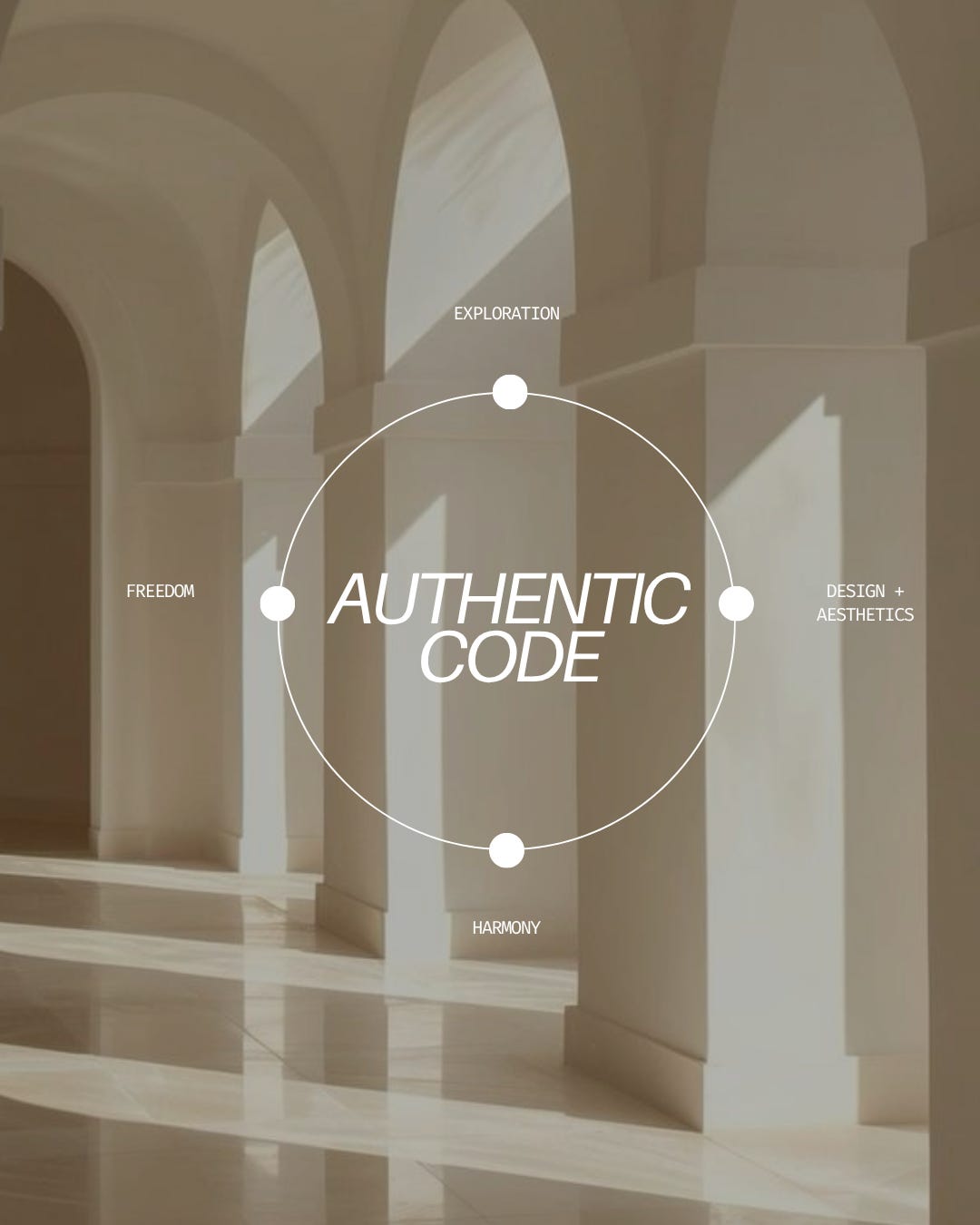
These four pillars are the ones I’ve returned to again and again — in lifestyle, in travel, in work, in the quiet decisions that shape a life.


I. Exploration
Curiosity, trial, learning, discovery, travel, growth, wonder.
Exploration is not just travel — though travel is its most visible expression. It’s the orientation toward the unknown that makes me feel awake. The willingness to try something before I know how it ends. Sojourne exists because of this pillar. So does every new hyper-fixation, every solo walk through a city I don’t know yet, every book I pick up on a subject I have no background in. I am most myself when I am in the middle of discovering something.
II. Design + Aesthetics
Creativity, curation, beauty, style, imagination, artistry.
My design background isn’t just professional history — it’s how I think. Beauty is not a luxury in my world; it’s a signal. When something is well-made, considered, and intentional, I feel it in my nervous system. This pillar shows up in how I create a seasonal menu, how I approach a Substack post, how I chose the hotel we stayed in last September. Aesthetics is not vanity. It’s integrity — the outer world made to match the inner one. Sense of place is my absolute lifestyle guide.
III. Harmony
Personal balance, abundant time in nature, alignment with natural cycles (seasons, astrology, femineity).
Harmony is the one I’m still learning to protect. It asks for slowness in a world that rewards speed. It shows up in how I structure my creative work around seasons and my cycle, in the hours I spend outside that aren’t earned or scheduled — just taken. In the instinct to pause when something feels forced. The disruption of harmony is the first sign that something is out of alignment. I’ve learned to treat that dissonance as data, not weakness. If I’m slow enough to tune in to what is really coming up for me, not just rushing past it, I feel in balance. Time in nature is my quickest throughline to self.
IV. Freedom
Limitless, individuality, time wealth, remote work, flexibility, financial independence, flow.
Freedom is the why behind most of the big decisions I’ve made in my adult life. A degree in communication + business = not being boxed into any one path (just open enough to go anywhere). A career in sales = freedom in my schedule (just hit your number). A design career = creative expression (just for the client and the firm). I’ve optimized for freedom my whole life without realizing I'd named it. Now I’m building something of my own that could travel with me. Choosing time over title. Where the only ceiling is really just me. This pillar isn’t about having no commitments — it’s about ensuring every commitment I make is one I chose, freely, from a place of alignment rather than obligation. This is the one that truly keeps me in flow with life.
Using Your Code
Once your pillars are clear, the decision-making process changes — not because the choices get easier, but because you stop auditioning them against external benchmarks. You start running them through something internal instead.
Does this support at least one pillar? Does it compromise another? Ideally, it lights up all four. That’s the filter.
I used mine to navigate one of the bigger decisions of my life: leaving my full-time interior design career to build something of my own. When I ran that job through my code honestly, only one of my four pillars was being upheld, the obvious one: Design + Aesthetics. The work was an obvious connection to this pillar. But it wasn’t expansive, it wasn’t mine, and it didn’t fit into the life I want to live. One out of four wasn’t enough. And that kept resurfacing time and time again when I could justify staying another month after month. The code made that clear in a way that months of deliberating hadn’t.
That’s what a well-honed code does. It cuts through the noise of what looks good on paper and gets honest about what actually fits.
And it’s worth revisiting — not on a schedule, but whenever you start to feel a low-grade disconnection from yourself. A subtle flatness. The sense that you’re going through the motions of a life that used to feel like yours. That’s the signal. When it comes, return to the prompts. Sit with your pillars again. Your code doesn’t change dramatically over time, but it deepens, it refines — and sometimes what you thought was a pillar turns out to be a preference, and something you’ve been quietly living all along finally has a name.
Your code is already written. You’re just learning to read it.
If this resonated, I’d love to hear what pillar surfaced first for you — or what surprised you when you sat with the prompts. Reply here, or find me on Instagram. This is the kind of conversation I’m always glad to keep going.
I absolutely love this concept❣️❣️